

Honorary graduate and award-winning Scottish writer Billy Kay, has launched his new book Born in Kyle, which goes back to his linguistic and cultural roots and celebrates a sense of place and belonging in his native Galston in Ayrshire’s Irvine Valley.
Billy Kay is one of the most influential figures in the Scots revival of the late 20th and early 21st centuries. Through radio, television, plays, creative writing and especially his hugely influential book Scots The Mither Tongue, Billy’s work helped change negative attitudes surrounding Scots and paved the way for its extended acceptance as a key element in Scottish cultural identity.
On receiving his honorary doctorate in 2019 in Troon Billy commented: “I was delighted to hear that my work in promoting Scottish culture has been recognised by the University.”
“As an Ayrshireman born and bred it gave me great pride to receive such recognition in my hame county – my love for my native culture stems from the people I came from in that part of the world – so it was a great day for the Kay family and friends of the family in Ayrshire.”
Read more: Scottish Writer and Broadcaster Recognised at UWS Graduation Ceremony
In Born in Kyle Billy writes about working class family life and the loving environment created by his parents and extended family; about enduring cold winters in a council house where the only source of heat was a coal fire and a paraffin heater. He writes about what they ate and drank; about how children passed their time by collecting everything from football cards to war medals; the richness of the Scots-speaking world they inhabited, using words and sayings with a pedigree going back hundreds of years; the influence of American music and movies coming into the Irvine Valley; the strong sense of community that came from a still living mining tradition; the football heights and the gambling lows; through the singing of Scots songs, the awareness of the poets who had gone before and who gave the people an identity they celebrated at family gatherings; local religious observation and the good folk from the respectable working class who looked down on the minority who indulged in ugly sectarian nonsense.
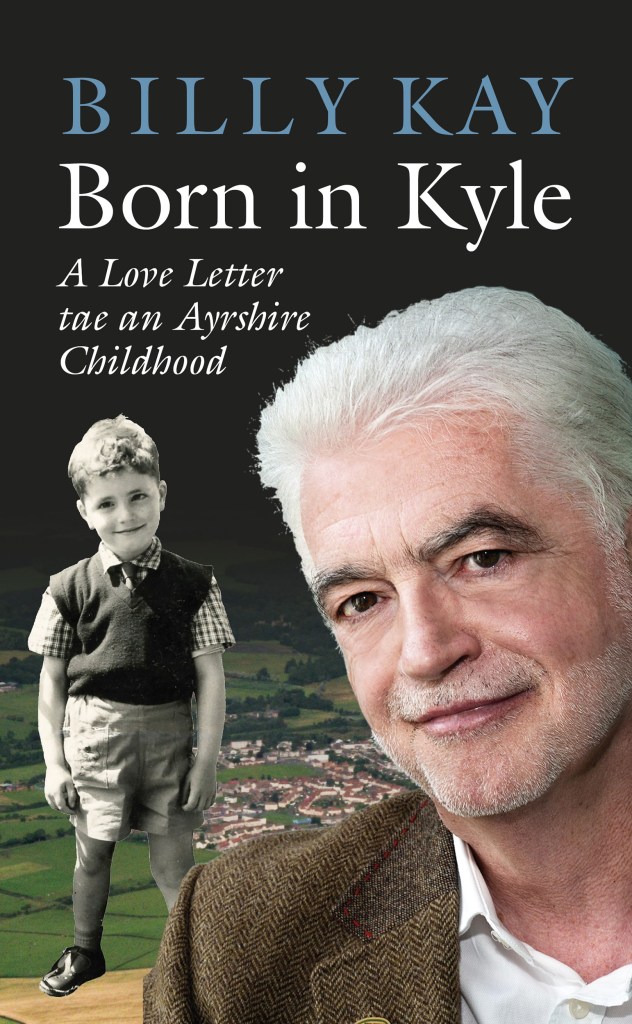
Looking back, Billy realises that his was the last of the pre television generations, and life was lived in a strong Scots-speaking environment which would be eroded when television in English was beamed into every household from the early 1960s onwards. In a vivid, gutsy and realistic Scots prose shot through with humour, Kay brings alive the characters he grew up with, some in personally recalled memoirs, others in short stories which bring out a history and a literary history inherited by local folk going back hundreds of years. Kay acknowledges Burns in the title of the book – like the bard himself, he was born in Kyle. But perhaps the greatest influence on this work is from another Ayrshire writer, John Galt’s whose 19th Century work Annals of the Parish gave a vivid account of an Ayrshire parish at the end of the 18th and beginning of the 19th Century. In Born in Kyle Billy Kay attempts to do something similar for his own parish and its life in the middle of the 20th Century.
For more information about Billy, visit www.billykay.scot
 WEST | Alumni Blog