
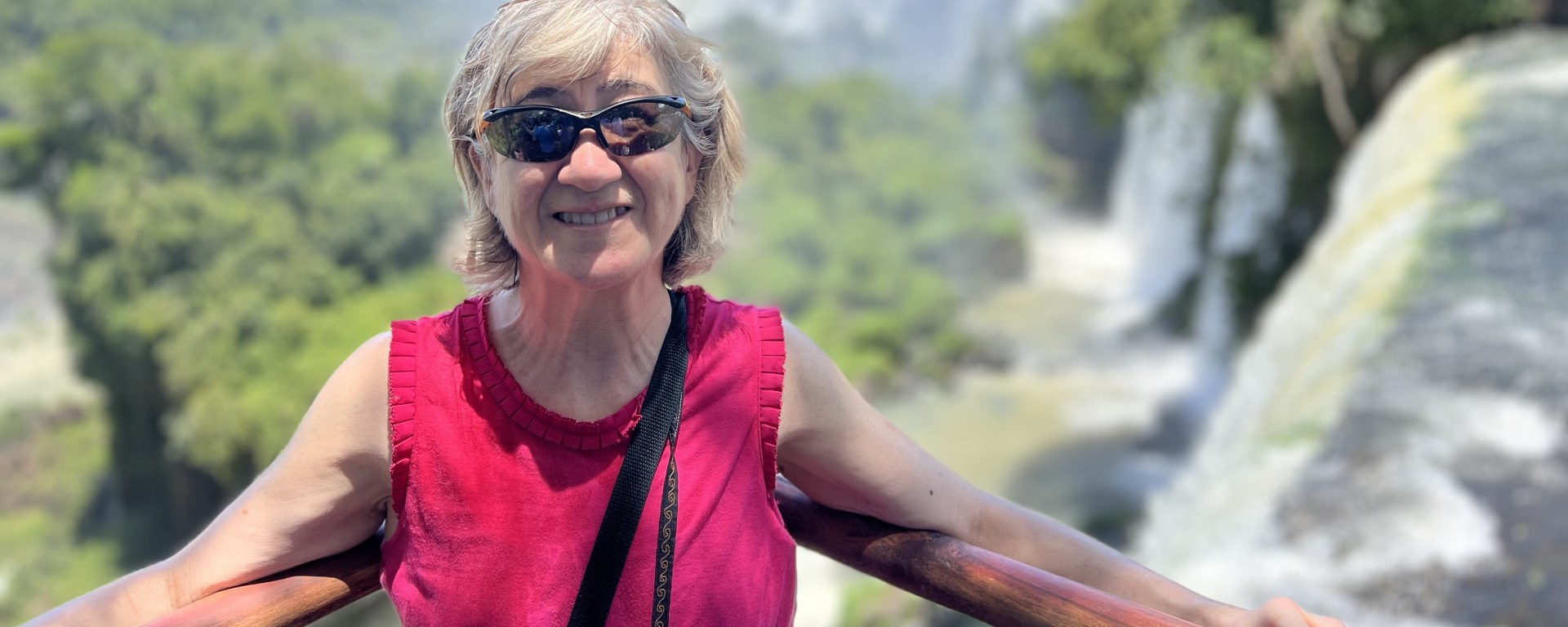
“Paisley was not just an education for me, it was a life experience allowing a great chance to transition to an adult capable of taking on a career in science.”
To celebrate International Day of Women and Girls in Science, on 11 February 2025, we are shining a light on an inspiring graduate who is paving the way for future generations of women and girls to succeed in the field of science and STEM.
International Day of Women and Girls in Science is an annual observance adopted by the United Nations General Assembly, to promote the full and equal access and participation of females in science, technology, engineering, and mathematics.
In this alumni profile we hear from Biology graduate (1987) Linda Brooks who is Research Services Manager EMEA at Thermofisher Scientific.
Tell us about your time at the University/College
I have fond memories of my time at Paisley. From my school education I had an incredibly strong interest in Biology although at that time I had no idea how that should translate into a career. I visited Glasgow, Strathclyde and Paisley open days – Paisley geographically was my nearest, however it was not only proximity that drove my decision to apply there – Paisley College (as it was then, now UWS) was positioned to be a very applied and hands on experience – with excellent lecturing staff with a passion for Biology.
As it turned out that was my experience and I recall lecturers like Dr Gordon Bickerstaff and others who definitely continued the excitement for the topic. These lecturers did not just turn up for work – they had a vested interest in the success of their students – including work placements and eventual careers. I am deeply grateful for their commitment to this day.
I recall that we were encouraged to apply for jobs even between the third and fourth year of the course – to get interview experience. I applied to ICI. My lecturers assisted the preparation – I remember taking a train down to Manchester – ICI were to pick me up. They sent a chauffeur-driven Jaguar with a guy in a suit, cap and driving gloves. Clearly I didn’t think he was there for me – so I went into a phone box (think Dr Who) to call ICI and he knocked the door to retrieve me. The interview went well after that and it was a great experience.
Paisley was not just an education for me, it was a life experience allowing a great chance to transition to an adult capable of taking on a career in science. It was not just hard work – we had a lot of fun too – I got the chance to participate in the BUNAC (British Universities North America Club), in effect a student exchange.
During the summer of my first and second year my college friend and I went to Pennsylvania to Summer Camp for kids (New Jersey Y camps). Our job was to do the laundry for 1000 children! It was super-hard work and it taught me a lot about work ethics and how they differ between countries.
Since I eventually went on to work for an American company that has stood me in good stead throughout my career. Again, it wasn’t just all work and no play – it allowed us to travel to Disney and Cape Canaveral to see the space mission museum. I highly recommend it and similar programmes if you get the chance.
Tell us about your experiences since leaving the University/College
When I left Paisley with my BSc (Hons) Biology, the obvious path to me at the time was to go into scientific research and to me that meant further degrees. So I looked at what interested me most and in 1987 Biotechnology was just taking off.
Yoshizumi Ishino and his team discovered CRISPRs, or clustered regularly interspaced short palindromic repeats, in E. coli. CRISPRs are repeating DNA sequences in the genomes of prokaryotes, like bacteria and archaea. So I looked to London and Imperial college had an M.Sc. in Biotechnology and Bio-Engineering.
However, this course was unfunded, so I decided to search the library for sources of charitable funding that might help and at the same time applied for jobs (being a very practical Scot!). I moved in with my Aunt in London and waited to see what arrived first; the funding or the job. I did get some very positive responses from the charities, but then a job came for a lab technician in the Royal Postgraduate Medical School in Hammersmith that could jumpstart my career.
In the early days I was working on a project with human umbilical cords from the local maternity hospital, which I had to collect every day from the labour suite! I would run in and out of that suite in double-quick time with the fresh umbilical cords in jars into a taxi to take me back to the lab. In my haste, one day I must not have screwed the caps on tightly enough – and I remember myself and a horrified taxi driver trying to recover the umbilical cord which had somehow got out of the jar. My interests still lay with protein engineering and not pharmacology, so I took a job at Imperial college in South Kensington as a Research Assistant and they paid for me to do an additional course in Protein Engineering (evenings 2 nights a week).
This led to a job at Strathclyde University studying antibody engineering. The lab had to be built from scratch for molecular biology, and I was tasked with meeting all the Sales reps for equipment and consumables. They all seemed incredibly well-trained and to me it seemed a more stable career, so I applied and got my first Sales role at Life Technologies in Paisley. It was a baptism of fire from science to sales but my impression of sales changed forever. It taught me the ability to think on my feet and much more. Within Life Technologies I became a Senior Technical Specialist for Gateway Recombinational cloning, then I saw a market opportunity for Contract Research – which I pitched to our then General Manager who luckily agreed with me and created a new role. I now lead that team in EMEA and our Research Services Business is as exciting to me now as it was in the early days.
Alumni career advice
My top tip would be to follow your passion and give it 110%.. If you are not in the right course for you or if you find yourself in the wrong job – change that quickly. There are so many opportunities out there – and they may not be obvious at the time. Get a mentor to support your decisions.
What drives you on
Its a bit of a cliche but I am still driven by the love of science but also of business – both to me are still fun. Now as a Manager of people – I enjoy seeing them grow.
 WEST | Alumni Blog